

All You Need to Know About Pregnancy Workouts for Every Trimester
Your workouts don't need to stop: find pregnancy-safe workout plans for every trimester with the WEGLOW App
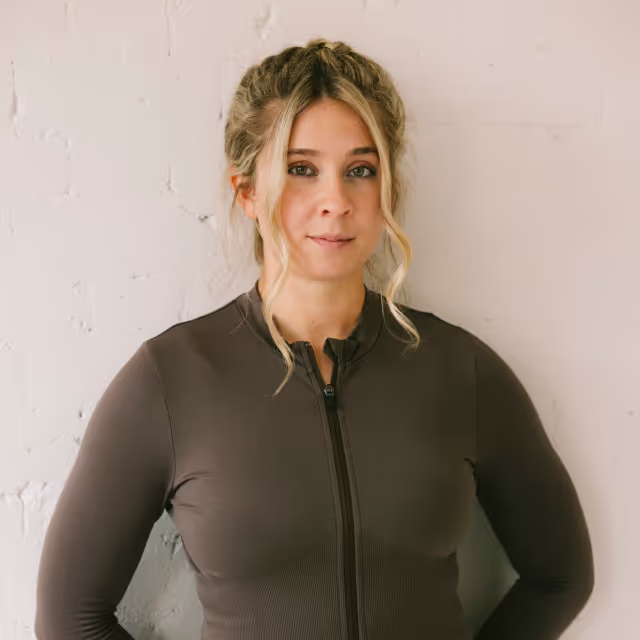
A workout by Anna Hage

Pregnancy is a journey of constant change, and your workouts should change with you. That's why WEGLOW's pregnancy workout plans are split into three trimester-specific phases. Rather than expecting you to follow one routine from the beginning of pregnancy to the day you give birth, each plan is designed to support the stage you're in, helping you adapt your training as your body, energy levels and needs change.
From building a strong foundation in the first trimester to maintaining strength and stability as your bump grows, our pregnancy fitness plans give you structured workouts while leaving room to listen to your body and adjust when you need to.
The number one rule is to first check in with your OB-GYN or midwife before starting or changing any exercise routine, especially if you have a high-risk pregnancy.
Want workouts built specifically for pregnancy? WEGLOW's Pregnancy Powered Program, led by Stef Williams, gives you a complete prenatal Pilates fitness program from 10-45 minutes, for every fitness level. Or plan your exercise trimester by trimester with Anna Hage. Start your free trial to try our pre and post-natal programs inside the app.
Is it safe to work out while pregnant?
For most healthy, uncomplicated pregnancies, yes. ACOG's official guidance states that physical activity in pregnancy carries minimal risk and benefits the majority of women, and it actively encourages both aerobic exercise and strength conditioning before, during, and after pregnancy.[1]
The general target, echoed by ACOG, the NHS, and the WHO, is:
- At least 150 minutes (2.5 hours) of moderate-intensity aerobic activity per week, spread across most days rather than done all at once. [1][2]
- Strength training on 2 or more days a week, working the major muscle groups.
- If you were already doing vigorous exercise (like running) before pregnancy, you can typically keep going at your usual intensity, with your care provider's sign-off — you don't need to suddenly scale back to "moderate" just because you're pregnant. [1]
- If you weren't active before pregnancy, start gently — short walks are a great entry point — and build up gradually.[4]
A simple way to gauge intensity is the "talk test": if you can hold a conversation while exercising but couldn't sing, you're in a safe, moderate zone.[1]
Before starting any new routine, ACOG recommends a clinical check-in first, since a small number of women have medical or obstetric reasons to modify or avoid certain activity.[1]
Can I get a pregnancy workout plan by trimester?
Pregnancy and post-natal fitness expert WEGLOW Trainer Anna Hage also has three individual pregnancy fitness programs designed for the demands and needs of each Trimester:
Strong & Supported: Trimester 1
Strong & Supported: Trimester 2
Strong & Supported: Trimester 3
As well as a selection of strength training workouts for all stages of pregnancy and postpartum.
Download the WEGLOW app and discover all pregnancy exercise programs and standalone pregnancy workout sessions, choosing from strength, barre, yoga and Pilates
How should I exercise during each trimester?
First trimester (weeks 1–13)
Energy levels and nausea vary hugely here, so this trimester is often about maintaining your existing routine rather than pushing for new gains.
- Continue whatever moderate cardio and strength training you were already doing, adjusted for energy and how you feel.
- Good options: walking, swimming, stationary cycling, low-impact cardio, and modified strength training. [5]
- If you're new to exercise, start with 10–20 minute walks most days and build from there.
- Avoid overheating, stay hydrated, and don't push through nausea or dizziness.
Second trimester (weeks 14–27)
Many women feel their best energy in this trimester, but your changing centre of gravity and loosening ligaments (from the hormone relaxin) mean balance and joint stability need more attention.
- From around 16 weeks, avoid exercises that involve lying flat on your back for extended periods, as this can compress the vena cava and reduce blood flow — short spells of a few minutes are generally considered fine if you feel well, but check with your provider. [6]
- Favour supported or seated core work over flat-back sit-ups.
- Continue aerobic work (brisk walking, swimming, cycling on a stationary bike) plus resistance training with moderate weights.
- Reduce or avoid activities with a high fall risk (outdoor cycling, horseback riding, downhill skiing) and contact sports. [3]
- Steer clear of sports involving equipment that could strike your abdomen, such as tennis or squash, from this stage onward. [6]
Third trimester (weeks 28–40)
Movement should feel manageable and comfortable, not maximal. Priorities shift toward mobility, pelvic floor health, and preparing your body for labour and recovery.
- Lower-impact cardio (walking, swimming, prenatal cardio classes) and lighter resistance training are ideal.
- Pelvic floor and breathing exercises become especially valuable as you approach labour.
- Balance may be affected as your bump grows, so choose stable, supported movements over anything requiring quick direction changes.<sup>[6]</sup>
- It's normal to slow your pace or shorten sessions — consistency matters more than intensity here.
Which exercises and activities should I avoid during pregnancy?
Across ACOG, NHS, and WHO guidance, the activities most consistently flagged as unsafe during pregnancy include:<sup>[1][3]</sup>
- Contact sports (e.g. hockey, boxing, football)
- Activities with a high risk of falling (downhill skiing, off-road cycling, horseback riding, gymnastics)
- Scuba diving and skydiving
- Hot yoga or hot Pilates
- Exercise at altitude above roughly 6,000 feet (1,800 m) without prior acclimatisation
- Extended periods flat on your back after the first trimester
- Any activity where you can't hold a conversation comfortably (a sign of overexertion)
Warning signs: when to stop exercising immediately
Stop exercising and contact your midwife, doctor, or maternity unit straight away if you experience any of the following: [3][7][8]
- Vaginal bleeding
- Regular, painful contractions
- Fluid leaking (waters breaking)
- Dizziness, feeling faint, or a severe headache
- Chest pain or a racing/irregular heartbeat
- Shortness of breath before you've even started exerting yourself
- Abdominal or pelvic pain
- Calf pain or swelling (possible sign of a blood clot)
- Muscle weakness affecting your balance
- Reduced or absent baby movements — contact your maternity unit immediately, don't wait [8]
Is it safe to start a new workout routine if I wasn't active before pregnancy?
Yes. ACOG guidance specifically encourages previously sedentary women to begin exercising during pregnancy, not just those who were already active.<sup>[1]</sup> Start gradually — short walks of 10–15 minutes are a good starting point — and build up toward the general target of 150 minutes of moderate activity per week, checking in with your midwife or doctor first. [1][4]
How much exercise should I do per week during pregnancy?
Most guidelines converge on roughly 150 minutes (2.5 hours) of moderate-intensity aerobic activity per week, spread across most days, plus strength training on two or more days.<sup>[1][2]</sup> That could look like 20–30 minutes of activity most days, such as brisk walking, swimming, or a modified strength session.
Can I do abs or core exercises while pregnant?
You can, but with modifications. From around the second trimester, avoid exercises that keep you flat on your back for long stretches, since this can reduce blood flow to the uterus. [6] Supported positions — side-lying, seated, kneeling, or using an incline — are generally better choices, and it's worth being mindful of ab separation (diastasis recti), which is common in later pregnancy. A prenatal-specific program, or guidance from a pelvic health physiotherapist, can help you train your core safely.
Can I keep running or lifting weights while pregnant?
If running, jogging, or strength training was already part of your routine before pregnancy, you can typically continue at a similar level with your care provider's approval, adjusting intensity as your pregnancy progresses.<sup>[1][3]</sup> It's not usually necessary to stop these activities purely because you're pregnant — the main advice is to listen to your body, avoid new high-impact or high-risk activities, and watch for the warning signs above.
What are the benefits of exercising during pregnancy?
Research links regular prenatal exercise to a lower risk of excessive gestational weight gain, reduced risk of gestational diabetes and pre-eclampsia, improved mood, better sleep, and a potentially easier postpartum recovery.[1][9] Exercise has not been shown to significantly limit weight gain on its own — nutrition plays the bigger role there — but the cardiovascular, metabolic, and mental health benefits are well established. [9]
This article is for general information only and isn't a substitute for personalised medical advice. Always speak with your OB-GYN or midwife before starting, changing, or continuing an exercise routine during pregnancy.
Sources
- American College of Obstetricians and Gynecologists (ACOG) — Physical Activity and Exercise During Pregnancy and the Postpartum Period
- World Health Organization — WHO Guidelines on physical activity, referenced via ACOG and international guideline comparisons
- Doulas of North America (DONA) — New ACOG Opinion on Exercise in the Childbearing Year
- NHS-affiliated guidance — Physical Activity During Pregnancy, Norfolk and Waveney Community Health
- NCBI/StatPearls — Pregnancy And Exercise
- Ascenti (physiotherapy provider) — Exercising during pregnancy: Safe guidelines and benefits
- Leicestershire Partnership NHS Trust — Exercise guidance during pregnancy (PDF)
- Tommy's (pregnancy charity, NHS-partnered) — When to stop exercising in pregnancy
- ACOG Committee Opinion No. 804, as summarised in peer-reviewed literature on maternal exercise outcomes


.jpeg)
FAQ's
Can I keep going to the gym while I'm pregnant?
For most people with a healthy, low-risk pregnancy, continuing to train at the gym is not only safe but actively encouraged, current guidance from bodies like the NHS and the Royal College of Obstetricians and Gynaecologists supports staying active throughout pregnancy. That said, "carrying on as normal" isn't quite the right approach. Your workouts will need to evolve: heavy lifting, high-impact movements, exercises lying flat on your back beyond the first trimester, and anything with a risk of falling or abdominal impact should be modified or swapped out. Many people find that lighter weights with higher reps, machine-based work, and a stronger focus on glutes, back, and pelvic floor serve them much better as pregnancy progresses than chasing PRs. If you're new to the gym or returning after a break, pregnancy isn't usually the time to start an intense new programme but gentle, guided strength and mobility work is generally a good idea. Always check with your midwife or GP before starting or continuing a gym routine, particularly if you have any pregnancy complications, and listen to your body over any plan on paper.
How often should I exercise during pregnancy?
Current guidelines suggest aiming for around 150 minutes of moderate-intensity activity per week during pregnancy, broadly the same recommendation as for non-pregnant adults spread across most days of the week. "Moderate intensity" means you can still hold a conversation while moving; if you're too breathless to talk, it's a sign to ease off. This can include a mix of walking, swimming, prenatal strength sessions, yoga, or pilates, and you don't need to do it all in one go, three 10-minute walks count just as much as a single 30-minute session. Consistency matters more than intensity here. Shorter, regular sessions tend to feel more sustainable than ambitious workouts you can only manage occasionally, and they help with energy levels, sleep, mood, and recovery after birth. Some days you'll feel up for a full session; other days a gentle walk is plenty. As always, your healthcare provider is the best person to confirm what frequency and intensity is right for your specific pregnancy. Giving birth is a massive workout for your body so making sure its fit and healthy is really important.
Is WEGLOW a good fitness app for women and what makes it different?
WEGLOW offers varied training styles (Strength, Pilates, cardio, yoga, barre, meditation and more), weekly new content, and built-in tracking (PBs, badges, stats, progress photos). Most importantly, 98% of women that use our fitness app and stick to their plan see results in 8 weeks1
Is WEGLOW the best women’s fitness app for personalized workout plans?
Yes, we think so, It offers goal-based programs, from strength training and yoga to pre or post-pregnancy fitness. The app tailors workouts to your fitness level, tracks progress, and includes nutrition guidance, making it a top choice for women seeking a complete fitness solution.
