
The Best Way To Lose Belly Fat For Women
Unlock More Content In Our App For Free
Join thousands of women transforming their fitness journey with personalised workouts, expert trainers, and a community that lifts you up.
Start free trial
The Best Exercises to Lose Belly Fat
Hundreds of crunches won't shift the fat sitting over your stomach, but a brisk run, a hard cycle or a set of heavy squats can. The best exercise to lose belly fat is the one that raises your heart rate and uses a lot of energy across your whole body, because your body draws on fat stores from everywhere at once, not from the muscle you happen to be working. Visceral fat, the deeper type of fat packed around your organs, responds particularly well to cardio, and it can start shrinking before the scales show much change at all.
That's good news if you've spent months on ab circuits with nothing to show for it. Below, we rank the main options by what the research shows about abdominal fat, the time each one asks for and how easy it is to keep doing, then turn them into a plan you can follow.
Why ab exercises can't spot reduce belly fat
Fat cells don't belong to the muscle underneath them. When you're in a calorie deficit, your body releases stored fat into the bloodstream and uses it as fuel wherever energy is needed, so your body doesn't burn fat from your stomach simply because your stomach is working. Genetics, age and hormones decide where you hold excess fat and the order it comes off, and for many women the middle is the last place to change. Fat storage patterns also shift around menopause, as falling oestrogen nudges more fat towards the waist.
The evidence against trying to spot reduce is fairly consistent. A 12-week trial of 40 overweight and obese women, published in the Journal of Manipulative and Physiological Therapeutics, compared a diet alone with the same diet plus abdominal strength work. Both groups lost fat under the skin of the stomach, and the extra ab training made no significant difference. Your abdominal muscles got fitter. The fat on top didn't notice.
There's one counterpoint worth knowing about. A small 2023 trial in Physiological Reports found that overweight men who swapped part of their running for abdominal endurance work lost more trunk fat than men who only ran, with energy use matched between the groups. It involved just 16 men over 10 weeks, so it's far from settled and tells us little about women. Our read: core work might nudge things at the margins, but it won't replace the options below.
How we ranked the exercises for belly fat
We weighted the evidence on fat around the organs most heavily, favouring studies that measured deep fat with CT or MRI scans rather than a tape measure. After that, we looked at the exercises that burn the most energy for the time you have, and how kind each exercise is to beginners and sore joints. The workout you skip uses nothing, so sustainability isn't a soft extra here. It's the whole game.
Why focus on fat you can't see? The National Institute of Diabetes and Digestive and Kidney Diseases notes that extra fat around the abdomen raises the risk of certain health problems, and visceral belly fat in particular is closely linked with heart disease and type 2 diabetes. That makes this less about a flat stomach and more about what's happening underneath it.
Aerobic cardio has the most evidence behind it
A 2013 meta-analysis of 15 studies found that exercise alone, with no calorie restriction, can help reduce visceral fat in overweight adults. The authors concluded that moderate or vigorous aerobic training had the most potential, while low-intensity work didn't produce a significant change. Every included study ran for at least eight weeks, with two or more sessions a week.
Moderate exercise means you can talk but couldn't sing. Examples include brisk uphill walking, cycling, swimming, rowing and dance-based classes. The NHS activity guidelines ask adults for at least 150 minutes of moderate activity a week, or 75 minutes of vigorous activity, spread across four or five days. That's a sensible baseline to build on.
Aerobic exercise also improves cardiovascular fitness, sleep and mood, which make the rest of your routine easier to keep. If you only have room for one change this month, add three 30-minute cardio sessions.
High intensity interval training gets similar results in less time
A meta-analysis of 39 studies covering 617 people, just over half of them women, found that high-intensity interval training reduced total, abdominal and visceral fat, with no difference between the sexes. Running-based intervals appeared to outperform cycling for total and deep fat, although the authors described that as early evidence. Interestingly, intervals below 90% of peak heart rate did more for belly fat than all-out efforts.
So you don't need to finish on the floor. A simple format is 30 seconds of exercise followed by 30 seconds of rest, repeated 10 to 15 times. For mountain climbers, start in a high plank with your hands directly beneath your shoulders, then drive alternate knees towards your chest, keeping your core engaged so your hips stay level. For squat jumps, stand with your feet hip-width apart, sit back into a squat, then push through the floor and land softly. If jumping isn't kind to your knees, opt for a bike or rower and keep the same work-to-rest pattern.
The trade-off is recovery. HIIT is demanding, and daily sessions tend to leave you sore rather than leaner, so one or two a week is plenty.
Strength training protects the muscle mass you want to keep
Here's the part most belly fat guides skip. When you eat in a deficit without lifting, a share of the weight you lose comes from muscle, and that leaves you smaller but softer. Resistance training signals your body to hold on to muscle mass while fat comes off, which is what changes your body composition and the way your clothes fit.
Compound lifts work a large number of muscles at once, so they burn more calories per set than isolated moves. Squats, deadlifts, lunges and rows should be the backbone of your sessions. For a bent-over row, hinge forward with a dumbbell in each hand, keeping your back flat, then pull the weight towards your lower ribs and lower it under control. Add a little weight or a few reps each week, and log your personal bests as you go.
That gradual progression is what one WeGLOW member noticed while completing the Transform Challenge: "Each week I felt like the exercises were easier to do and the weights I could use were getting heavier." Our guides cover both gym and home training, so the same principle works whether you have a full rack or two dumbbells in the spare room.
Where core work actually fits
None of this means you should skip core training. Your core muscles brace your spine when you lift, carry and twist, and a well-trained core can help you squat and deadlift heavier with better form. Think of it as support for the training that shifts belly fat.
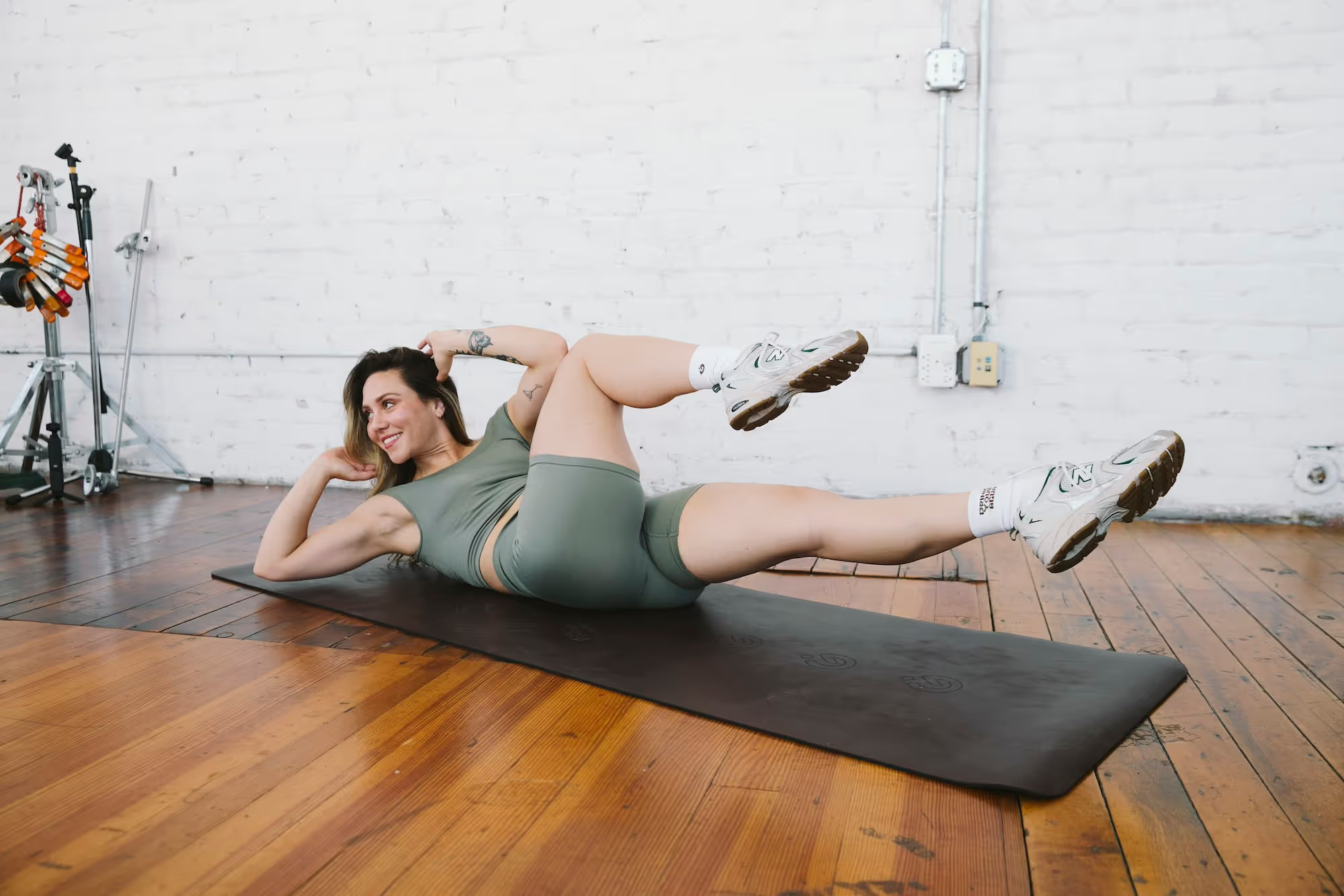
Two moves cover most of what you need. For a dead bug, lie on your back with your arms pointing at the ceiling and your knees bent at 90 degrees, press your lower back into the floor, engage your core, then slowly lower the opposite arm and leg. For bicycle crunches, lie on your back with your hands behind your head, lift your shoulders slightly and bring each elbow towards the opposite knee without yanking your neck. One exercise done slowly and well beats five rushed through at the end of a session.
A word of caution on quick results. If your stomach looks flatter after a week of planks, that's usually better posture, or habits that reduce bloating such as eating more slowly, rather than fat loss.
Your diet decides whether the calorie deficit happens
Exercise does burn calories, but fewer than most people expect, and it's easy to eat back a hard session in minutes. Creating a calorie deficit through diet and exercise together is the most reliable route to healthy weight loss, and the deficit only needs to be modest. Big cuts tend to backfire.
What you eat matters as well as how much. A 2014 Uppsala University study published in the journal Diabetes had 39 young adults overeat by 750 calories a day for seven weeks, using muffins made with either palm oil (high in saturated fat) or sunflower oil. Weight gain was similar, but the palm oil group gained more fat around the liver and abdomen and less muscle. It was a small overfeeding study, so treat it as a nudge rather than a rule: keep saturated fat moderate and cut back on consumption of foods that are easy to overeat, like pastries and processed snacks.
Sleep is the other lever. Short nights disrupt the hormones that regulate appetite, which makes a deficit harder to hold. WeGLOW's 700+ recipes come with full macro breakdowns, and our meal plans can be tailored to your calorie and protein target goals, which takes most of the guesswork out of eating for fat loss.
How long it takes to drop belly fat
The trials that cut visceral fat ran for at least eight weeks, so give any plan two to three months before judging it. The deep fat tends to respond first. Stubborn belly fat under the skin is often the last to shift and hard to lose, especially low on the stomach where many women carry their most stubborn fat, so track your waist, progress photos and strength, not just your body weight.
Hold a modest deficit alongside regular exercise and you'll continue to lose fat from everywhere, including belly fat, just not in the order you'd choose. Crash diets or daily HIIT won't speed up the process; they tend to cost muscle and motivation instead. No pill, wrap or detox tea will reduce fat around your middle either. Strength training may not move the scales much, but it can reduce body fat while adding muscle, so your total body fat drops even when your weight doesn't.
An app won't do the work on its own, and we'd rather say so. A 2019 review in the Journal of Medical Internet Research found only modest evidence that smartphone apps increase physical activity, with the clearest effects in the first three months. Structure helps. Turning up week after week is what keeps results going.
A weekly workout plan to lose belly fat
The best ways to combine everything above are simpler than most programmes suggest. Aim for two full-body strength sessions, two or three moderate cardio sessions of 30 to 45 minutes and one HIIT session, finishing two of those days with five minutes of core work. Keep at least one full rest day, and fill the gaps with walking: daily steps are one of the easiest ways to get more physical activity in without adding another workout.
If you're looking to lose belly fat for health reasons, consistency beats intensity every time. That's why our guides and challenges keep sessions to 45 minutes or less, and why one member told us: "the workouts are insanely good but they're not too long, which works amazing for me because I can always make time for it." The activity tracker and weekly planner help you map it all out.
Your cycle can help with planning too. If your energy dips in the days before your period, swapping HIIT for a walk or a yoga flow keeps the week moving instead of abandoned, and WeGLOW's cycle-syncing section suggests sessions by phase so you can plan around how you feel. Of all the ways to lose belly fat, the most reliable way to reduce it for good is the routine you're still following next month. That's where the best results come from.
AuthorStef Williams
FAQ's
How do I set calories for muscle gain or fat loss when I plan my week?
Pair training with a simple calorie target: for muscle gain, add a small surplus (about +125 to +500 kcal/day depending on the weekly rate you want) and keep protein around 1.6–2.2g/kg. For fat loss, create a modest deficit (about −250 to −1,000 kcal/day depending on the weekly rate you want) while prioritising lean protein, veggies and whole-grains. Then plan ahead—batch cook, build a varied menu, and keep flexible so life can still happen.
How accurate are the calorie and nutrition tracking features?
They can be helpful for awareness, but accuracy depends on how precisely you log your meals in the WEGLOW app.
How much protein do I actually need—and easy ways to hit it?
As a baseline, aim for ~0.75g per kg of bodyweight per day (e.g., ~50g for 65kg). If you’re training hard/heavy, 1.4–2.0g/kg can be appropriate. Build 15–30g into each meal (eggs, Greek yoghurt, tofu/tempeh, fish, lean meats, beans) and use protein-rich snacks to top up. If you’re still short, consider whey (or brown-rice protein if plant-based)—both are rich in leucine to support muscle protein synthesis.
Why is WEGLOW the best women’s workout app for beginners?
It provides free and paid, high-quality workout videos led by popular trainers, covering cardio, Pilates, HIIT, and more. The app also includes guided schedules and motivational tracking—perfect for women who are new to fitness and want to build consistency.


Related
Workouts
Workouts and fitness routines with our trainers to improve your health


50% discount on annual
Claim 50% off your yearly WEGLOW subscription
Unlock access to WEGLOW for 50% off when you buy an annual plan, very limited offer so hurry
get the dealLimited time offer · Terms apply