
Beginner Workout Plan For Women
Unlock More Content In Our App For Free
Join thousands of women transforming their fitness journey with personalised workouts, expert trainers, and a community that lifts you up.
Start free trial
A Full-Body Gym Workout Routine To Build Strength
You've decided to start training, and now you're either a few taps from downloading an app or stood in a gym you've already paid for but haven't used the way you hoped. That gap between showing up and knowing what to do is where most beginner workout plans fail before they've even started. A good beginner workout plan isn't one miracle routine: it's a structure you can repeat, adjust and stick with while your body adapts. A good workout for beginners prioritises consistency over intensity in the first few months, and the best workout is the one you actually finish, not the one that looks hardest on paper.
What a good beginner workout plan should include
Every effective beginner workout plan covers the same ground, whatever app or gym you follow it through. The CDC recommends adults aim for 150 minutes of moderate cardio a week alongside muscle-strengthening activity covering all major muscle groups on at least two days, usually in sets of 8-12 reps. A beginner workout plan should include a mix of full body training, some cardio, and rest days built in rather than treated as optional. Skip the rest days and you're not training harder: you're accumulating fatigue faster than your body can recover from it.
Beginners often assume a workout routine needs to be complicated to work. It doesn't. A simple beginner workout routine built around three full body sessions a week, with a rest day between each, gives your muscles time to recover while still training often enough to see progress. Strength training doesn't ask anything different of a workout routine for women compared with anyone else, though how you fuel and recover around your cycle might.
Inside WeGLOW, we've built these principles into structured guides rather than leaving you to work it out through a search engine. One member described moving on to the Glow at Home Guide at an intermediate level after knee surgery, precisely because a beginner workout plan should flex around what your body can currently do rather than force you into someone else's timeline. That's the real test of a good plan: whether you can still follow it when life, or your body, gets in the way.
Building your full body workout routine
A full body workout routine trains every major area in one session rather than splitting the week into chest day, leg day and so on. For beginners, this beats a split routine because you're hitting each muscle group two or three times a week instead of once, which speeds up how quickly you build muscle and get comfortable with the movements themselves. A typical full-body workout might pair a lower body compound move with an upper body push and pull, then a core exercise. Balancing upper and lower body work across the week stops you overtraining one half of yourself, and each session still works your entire body rather than one isolated part.
A workout routine most beginners can stick to looks something like this across a week:
- Monday: full body strength training, using dumbbells or machines
- Wednesday: full body strength training, plus 20 minutes of cardio
- Friday: full body strength training, with a short ab and glutes finisher
That 3 day full body split, repeated for six weeks, is the version most beginners should start with. Once a 3-day beginner workout routine feels manageable, it becomes a longer-term gym routine that flexes with your schedule. Training on non-consecutive days gives each muscle group roughly 48 hours to recover before you load it again, in line with the muscle-strengthening spacing already mentioned above.
If three days feels like too much time in the gym early on, two full-body sessions a week still count as a legitimate weight training workout routine, just with slightly slower progress. What matters more than frequency is consistency: an effective workout doesn't need to last an hour, and a full body workout plan followed for six weeks tells you more than switching plans every fortnight. PureGym's own guidance backs this up: full-body sessions let beginners make rapid early strength gains without spending hours in the gym each day. There's no single best gym workout plan that suits everyone, but full body, three times a week, comes close.
Strength training exercises for beginners
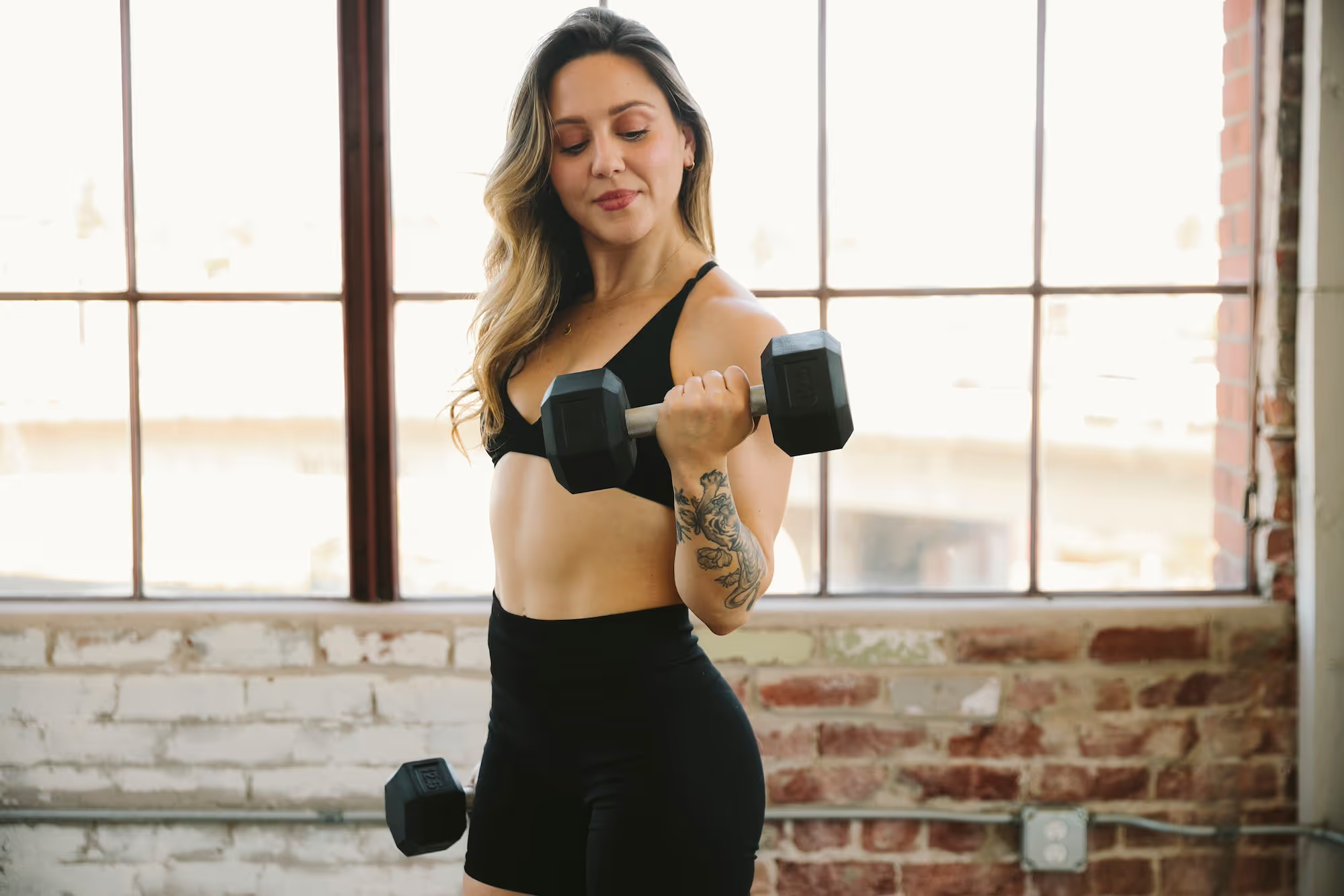
Strength training exercises for beginners don't need a rack of specialist gym equipment. A set of dumbbells, a bench and some floor space cover almost everything you need for your first few months, and this kind of training for beginners builds a foundation before anything heavier. A simple setup like this is perfect for beginners who don't want to commit to a full gym membership straight away. Goblet squats, dumbbell rows, shoulder presses and a chest workout move like a dumbbell press, paired with a row to balance the shoulders, work almost every major muscle in the body.
Free weights beat machines for beginners in one respect: they force you to control balance and stability rather than pushing a fixed bar along a track. Weight lifting through a full range of motion, done slowly and with good form, builds strength faster than rushing through reps with worse technique. Gradually increasing the weight, rather than jumping up in big steps, is the single habit that keeps beginners progressing month after month without injury or a plateau. A proper strength workout should leave your muscles fatigued, not leave you gasping for air.
This is also where a proper strength training programme earns its keep over a random collection of exercises pulled from social media. WeGLOW's guides are built by trainers like Alex, who structures each phase to gradually increase the intensity of your workouts rather than front-loading advanced moves. Compound lifts done consistently are still the fastest way to build lean muscle as a beginner, and that lean muscle keeps your resting metabolism higher. That structure is what turns a handful of exercises into an actual weight training workout you can trust, not just a list.
Lower body and glute exercises to build strength
Your lower body carries the biggest muscles in the body, so lower body training gives you some of the fastest visible results in a beginner workout plan. Squats, hip thrusts and Romanian deadlifts, using nothing more than a set of dumbbells, work the glutes, hamstrings and quads together rather than isolating one small muscle at a time. This lower body and glutes-focused workout for women is one of the most completed sections inside WeGLOW's own guides, based on completion data.
Beginners sometimes skip lower body day because it's the one that leaves you sore for longest, but skipping it slows progress everywhere else too: your legs and glutes support almost every other lift you do. Aim for two to three sets of 8-12 reps on your main lower body lift, add a single isolation move for the glutes or hamstrings, and increase the weight once the top of that rep range starts to feel easy rather than maximal. Building real body strength takes consistency measured in months, not single sessions.
Ab and core exercises to add to your routine
An ab workout doesn't need to mean hundreds of crunches. Planks, dead bugs and hanging knee raises engage your core more effectively than repetitive flexion movements, and carry over into every other lift in your routine. Two or three ab-focused moves at the end of a full body session are enough for most beginners: any more than that just adds fatigue without adding much benefit.
A capable midsection isn't only about how your abs look. Engaging your core properly during squats, presses and even walking protects your lower back and improves how much weight you can safely lift elsewhere in your workout plan. Any exercise routine works better with a written plan behind it than relying on memory alone. Pilates is worth adding here too: even one session a week improves the mind-muscle connection that makes every other ab exercise in your routine more effective.
Cardio, HIIT and rest days
Cardio isn't optional in a well-rounded workout plan, even if strength training is the part that changes your shape the most. A cardio workout raises your heart rate, supports fat loss alongside a sensible diet, and improves how quickly you recover between strength sets. You don't need hour-long sessions: 20 to 30 minutes, two or three times a week, on top of your full body training days, covers most of what a beginner needs, building both strength and endurance over time.
HIIT is worth trying once you're comfortable with the basics. Research summarised by Harvard Health notes that interval-based cardio can deliver similar fitness gains to longer, steady sessions in a fraction of the time, which matters if your daily workout has to fit around work or childcare. A kettlebell workout built around swings and short sprints is one of the simplest ways to bring HIIT into a beginner routine without needing a treadmill.
None of this works without rest days. Muscle building actually happens during recovery, not during the workout itself: training breaks down tissue, and rest lets it rebuild capable of handling more next time. Post workout recovery, protein, water and sleep, matters as much as the session itself. Skipping rest days too often is one of the fastest ways beginners burn out or get injured within the first month, especially once sessions start stacking up.
Tracking progress with workout apps
A written plan on paper works, but workout apps make it far easier to actually follow one. The best ones let you log reps, track how the weight you're lifting changes week to week, and remind you when a rest day is coming up. You can still train your whole body at home with nothing more than a set of dumbbells on days a home workout is the only option.
Inside WeGLOW specifically, that structure comes from real trainers rather than an algorithm alone: Stef, Alex and Mara each build out full body and cardio guides, with a weekly planner and personal-best logging built around them. An app that tracks progress over months, not a single session, is more motivating than any before-and-after photo. One long-term member described training as more a mental challenge than a pleasure some days, but said the guides and a community behind her got her through a six-month transformation programme.
Starting your beginner workout plan with WeGLOW
New to the gym and unsure where to begin is a normal place to start, not a problem to fix before you download an app or book your first workout session. A structured beginner workout plan, built around full body training, cardio, rest days and a way to track it all, will get you further than piecing together a free workout plan from scratch. You'll find a workout plan is best when it's simple enough to repeat for months, not just survive for one.
WeGLOW's guides are designed with exactly this entry point in mind: over 30 structured plans that scale from your very first visits to the gym through to advanced strength work, plus a cycle-aware element that adjusts around your energy rather than ignoring it. Every plan follows the same logic: a workout plan for women designed around real training data, not a generic template repurposed from a men's programme. Worth being honest about here: ACE Fitness's review of a 2025 McMaster University study found no measurable difference in muscle response across cycle phases, so cycle syncing isn't a performance hack. What does vary is energy, motivation and comfort, and WeGLOW members consistently report that syncing sessions to how they feel, not to a fixed protocol, is what keeps them showing up. A 6-week beginner workout block is usually enough to notice real change in how your clothes fit and how stairs feel, a better start than waiting to feel ready.
AuthorStef Williams
FAQ's
Do I need long resistance bands or other equipment to use WEGLOW?
Many of our classes are bodyweight, but some do require light dumbbells, booty (short) bands, long resistance bands, or sliders to intensify sessions. Head to the WEGLOW shop for “Burn Bands” and long “Build Bands” to participate in workouts that require additional items
How much protein do I actually need—and easy ways to hit it?
As a baseline, aim for ~0.75g per kg of bodyweight per day (e.g., ~50g for 65kg). If you’re training hard/heavy, 1.4–2.0g/kg can be appropriate. Build 15–30g into each meal (eggs, Greek yoghurt, tofu/tempeh, fish, lean meats, beans) and use protein-rich snacks to top up. If you’re still short, consider whey (or brown-rice protein if plant-based)—both are rich in leucine to support muscle protein synthesis.
Is there a good strength training app for women over 50?
Yes. Women over 50 benefit enormously from strength training for bone density, muscle retention, and metabolic health, but need programming that accounts for joints, recovery, and starting points. WEGLOW includes strength programmes appropriate for women over 50, with lower-impact options, sensible progression, and trainers who understand training in midlife and beyond. The focus is on building strength safely and consistently rather than pushing maximal intensity.
Is WEGLOW a good fitness app for women and what makes it different?
WEGLOW offers varied training styles (Strength, Pilates, cardio, yoga, barre, meditation and more), weekly new content, and built-in tracking (PBs, badges, stats, progress photos). Most importantly, 98% of women that use our fitness app and stick to their plan see results in 8 weeks1


Related
Workouts
Workouts and fitness routines with our trainers to improve your health


50% discount on annual
Claim 50% off your yearly WEGLOW subscription
Unlock access to WEGLOW for 50% off when you buy an annual plan, very limited offer so hurry
get the dealLimited time offer · Terms apply