
Weight Training For Women
Unlock More Content In Our App For Free
Join thousands of women transforming their fitness journey with personalised workouts, expert trainers, and a community that lifts you up.
Start free trial
Your Ultimate Guide To Strength Training That Fits Your Life
Weight training for women is one of the most effective ways to feel energised, build confidence in your body and support your long-term health, whatever your age or starting point. When you strength train regularly with a simple plan you actually enjoy, you support muscle, bones, heart health and mood, without needing hours in the gym.
- Strength training for women supports muscle mass, bone density, joint health and metabolic health across every life stage.
- Just two or more days of muscle-strengthening exercise each week is linked with better health outcomes and reduced risk of chronic disease.
- A realistic full body workout plan that fits your schedule, whether at home or in the gym, is the key to consistency, confidence and results.
Strength Training For Women Builds Health From The Inside Out
We talk a lot about visible changes, but the biggest benefits of strength training and building muscle sit deeper than any mirror check. Evidence in women shows that regular resistance training can lower the risk of type 2 diabetes by around 30 percent and also reduce cardiovascular disease, even after accounting for other activity.
Health organisations like the NHS and WHO recommend muscle-strengthening activities that target every major muscle group on at least two days each week, alongside aerobic exercise for heart and lung health. This mix of resistance training and aerobic exercise supports heart health, a healthy weight and day-to-day energy.
Research also links regular strength training with:
- Better bone density and reduced fracture risk, especially for women at higher risk of osteoporosis.
- More lean muscle and less body fat as we age, which helps counter the natural loss of muscle mass, often called sarcopenia.
- Lower risk of all-cause mortality, cardiovascular disease, diabetes and several cancers when muscle-strengthening activities are done each week.
A regular strength training workout may also support mood, body image and self-esteem, which is hugely important for women who have spent years being told to shrink rather than get stronger.
Our philosophy at WeGLOW reflects this: our training plans are designed to build strength, confidence and long-term health, not just short-term fat loss.
How Often You Need To Strength Train To See Results
Guidelines suggest that adults should complete muscle-strengthening activities on at least two days a week. Many women are not yet meeting these recommendations, despite clear evidence that regular strength training can help improve musculoskeletal health and reduce injury risk.
For most women, a realistic goal looks like this:
- Strength train two to three times a week, leaving at least one day between heavy sessions for recovery.
- Choose a full body workout or split upper and lower body sessions, depending on preference and schedule.
- Mix strengthening exercises with mobility exercises, walking or other low-impact movement on your non-lifting days.
Our guides and challenges are built around this pattern: they are designed to build strength with workouts up to 45 minutes that fit busy lives, not long sessions that only work if you already live in the gym.
Why We Love A Beginner Full Body Toning Workout
When you are new to strength training, a simple full body toning workout is often the best workout structure. It lets you train each major muscle group several times a week, which supports strength and endurance without needing a huge time commitment.
A full body session also suits women looking to build lean muscle, support fat loss and keep things efficient if you already have a gym membership or a busy home life. Our app focuses on compound exercises that train more than one muscle at once, so every minute counts.
Our Beginner Full Body Workout Plan For Women
Here is an example workout routine that you can follow at home or in the gym. It focuses on compound moves, uses dumbbell exercises and bodyweight exercises, and can be completed two to three times each week.
Warm-up: 5 minutes
- Gentle cardio, such as marching on the spot or light cycling
- Dynamic mobility exercises for hips, shoulders and spine
Strength section: 2–3 sets of 8–12 reps per exercise
1. Squat
Stand with your feet shoulder-width apart. You can start with body weight, then hold a dumbbell as you progress. Keep your chest lifted, sit your hips back and bend your knees until thighs are parallel to the floor, then push back up. This classic strength training exercise targets your lower body and core.
2. Dumbbell Romanian deadlift
Hold a dumbbell in each hand in front of your thighs, soften your knees, then hinge from your hips, keeping your back long. You will feel the back of your legs and glutes as the main muscle group working here.
3. Incline push-up or dumbbell chest press
For a home workout, use an incline push-up against a bench or sofa. For the gym, lie on a bench, hold a dumbbell in each hand and press up above the chest. This strengthens your upper body and supports upper body strength for daily tasks like pushing and carrying.
4. Bent-over row with dumbbell or barbell
Hinge forward from your hips, keep your spine long and row the weights towards your ribcage. This move builds back and arm muscular strength and helps posture, especially if you sit a lot for work.
5. Static lunge
Step one foot forward and lower the back knee towards the floor, then push through the front heel to rise. Alternate legs for each set. This is brilliant for lower body balance and body strength.
6. Plank
Come down to your forearms and toes, forming a straight line from head to heels. Hold for 20–40 seconds, resting as needed. The plank works your core, shoulders and glutes, and teaches you to brace the trunk, which carries over to every training workout you do.
7. Glute bridge
Lie on your back, knees bent, feet flat. Squeeze your glutes to lift your hips, pause, then lower with control. This supports hip stability and ties in nicely with lower body compound exercises.
For a true beginner, choose a weight that feels like a 7 out of 10 effort by the final rep of each set. You should finish your set knowing you could manage one or two more reps with good form, not eight more. As you gain confidence, you can gradually increase the weight over time.
How To Choose A Weight And Progress Safely
Progressive overload is the simple idea that, over time, you increase the challenge so your body keeps adapting. That might mean you increase the weight, add an extra set, add a rep or choose a slightly harder variation.
Practical training tips we share with our community:
- Start lighter weight than you think and build up, especially if you are beginning a strength training journey after a break.
- Aim for 2–3 sets of 8–12 reps on each movement, and keep a couple of reps spare in the tank.
- Use resistance bands to add challenge if you train at home without resistance machines or weight machines.
- Focus on control, especially in the lowering phase of each rep, which research links with better strength and muscle gains.
- Listen to your body, rest when you need to and remember that training doesn’t need to feel brutal to work.
Our guides are designed to build strength safely: each training plan is structured so you repeat key lifts often enough to improve technique, while our world-class coaches cue form in follow-along videos so you never feel lost, even if you are new to strength training.
Training Equipment Choices For Home Or Gym
You do not need a full studio to strength train effectively. You can get stronger with body weight alone, then add tools over time. Many women in our community start with:
- Bodyweight workouts using squats, lunges, glute bridges and push-ups
- A pair of dumbbells and some resistance bands
- Occasional kettlebell workout sessions once they feel comfortable with hip-hinge patterns
At the gym, you might work with free weights such as a barbell and dumbbells, cable systems, resistance machines and weight machines that guide the movement. Every tool has a place: our guides show how a simple workout combines compound lifts and isolation exercises so you cover every major muscle group efficiently, whether you train at home or in the gym.
Women often tell us that other apps feel repetitive, assume lots of equipment, or make it difficult to adjust around real life. We design our training program options so that beginners and advanced lifters can choose a routine for women that fits their space, kit and energy, without being locked into a rigid path that ignores rest days or travel.
How Strength Training And Weight Lifting Supports Long-Term Health For Women
Regular strength training can help women maintain a healthy weight, support glucose control and reduce body fat, especially when combined with daily movement and a balanced diet. A large body of research now links resistance training with lower risk of type 2 diabetes, coronary heart disease and heart disease in women, independent of other activity.
There is growing recognition that strength training may be one of the most practical tools we have to reduce the risk of osteoporosis and the loss of muscle mass that often accelerates after midlife. Working on strength and endurance also helps you stay active for longer, care for family, lift and carry without worry and feel more capable in daily life, not just during a workout.
Our WeGLOW guides are designed to help women at every stage of life: from beginners building confidence in their first strength training sessions, to women looking to build lean muscle in perimenopause while they manage changes to hormones and recovery. We include mobility exercises, breathwork, yoga and meditation so your body and mind get what they need across the week, not only during lifting weights days.
How WeGLOW Makes Weight Training For Women Feel Simpler
Many women feel put off by apps that glitch, lose their data, repeat the same sessions or make cancellation complicated. Our approach is different. WeGLOW offers:
- Over 2,500 workouts across strength, Pilates, HIIT, mobility and more, so you never feel stuck repeating the same sequence.
- Guides that are designed to build strength while still feeling achievable when life is hectic.
- Training can help you work with your menstrual cycle: cycle-syncing recommendations show you which training workout is better suited to each phase, so you can push harder when energy is higher and ease off when recovery needs more attention.
- World-class trainers who coach every rep with clear cues and progressions, almost like having a personal trainer in your pocket.
- Clear tracking of reps, sets and personal bests, so you see exactly how you get stronger over time, even when the mirror looks the same.
Our mission is simple: help women feel capable, educated and supported so regular strength training becomes a habit, not a phase.
Putting It All Together
When you focus on strength training for women with a simple, realistic structure, everything starts to join up. You follow a workout plan that matches your current level, you use dumbbell exercises, bodyweight exercises and other strengthening exercises that focus on compound exercises, you work every major muscle group and you repeat that pattern two to three times a week. Over time, regular strength training can help you get stronger, support upper body strength and lower body power, protect bone density and reduce the risk of osteoporosis.
We design each guide as a plan for women that is designed to build strength, support fat loss, maintain muscle mass and help women feel more confident with every training workout. The best full body sessions and split days in our app are built by experts who understand how strength training may interact with hormones, life stages and energy, and every workout for women includes mobility work, so your workout routine stays kind to your joints as you build strength and muscle.
Whether you are beginning a strength training journey, looking for the best routine for women who train at home, or simply curious about how focusing on strength training could support a healthy weight, our message is the same: start strength training with simple movements, gradually increase the weight when you feel ready, keep your feet shoulder-width apart in the big lifts, breathe, listen to your body and remember that consistency beats perfection every time.
AuthorAnna Hage
FAQ's
How does WeGLOW adjust my workouts based on my menstrual cycle, and how should I use it to stay consistent
WeGLOW uses your menstrual cycle phase (for example, follicular, ovulation, luteal, and menstrual) to recommend workouts that are better aligned with the physical changes and energy levels you might experience in each phase.
How do I set calories for muscle gain or fat loss when I plan my week?
Pair training with a simple calorie target: for muscle gain, add a small surplus (about +125 to +500 kcal/day depending on the weekly rate you want) and keep protein around 1.6–2.2g/kg. For fat loss, create a modest deficit (about −250 to −1,000 kcal/day depending on the weekly rate you want) while prioritising lean protein, veggies and whole-grains. Then plan ahead—batch cook, build a varied menu, and keep flexible so life can still happen.
Is WeGLOW a good fitness app for women and what makes it different?
WeGLOW offers varied training styles (Strength, Pilates, cardio, yoga, barre, meditation and more), weekly new content, and built-in tracking (PBs, badges, stats, progress photos). Most importantly, 98% of women that use our fitness app and stick to their plan see results in 8 weeks1
Is WeGLOW the best women’s fitness app for personalized workout plans?
Yes, we think so, It offers goal-based programs, from strength training and yoga to pre or post-pregnancy fitness. The app tailors workouts to your fitness level, tracks progress, and includes nutrition guidance, making it a top choice for women seeking a complete fitness solution.
How accurate are the calorie and nutrition tracking features?
They can be helpful for awareness, but accuracy depends on how precisely you log your meals in the WeGLOW app.


Related
Workouts
Workouts and fitness routines with our trainers to improve your health


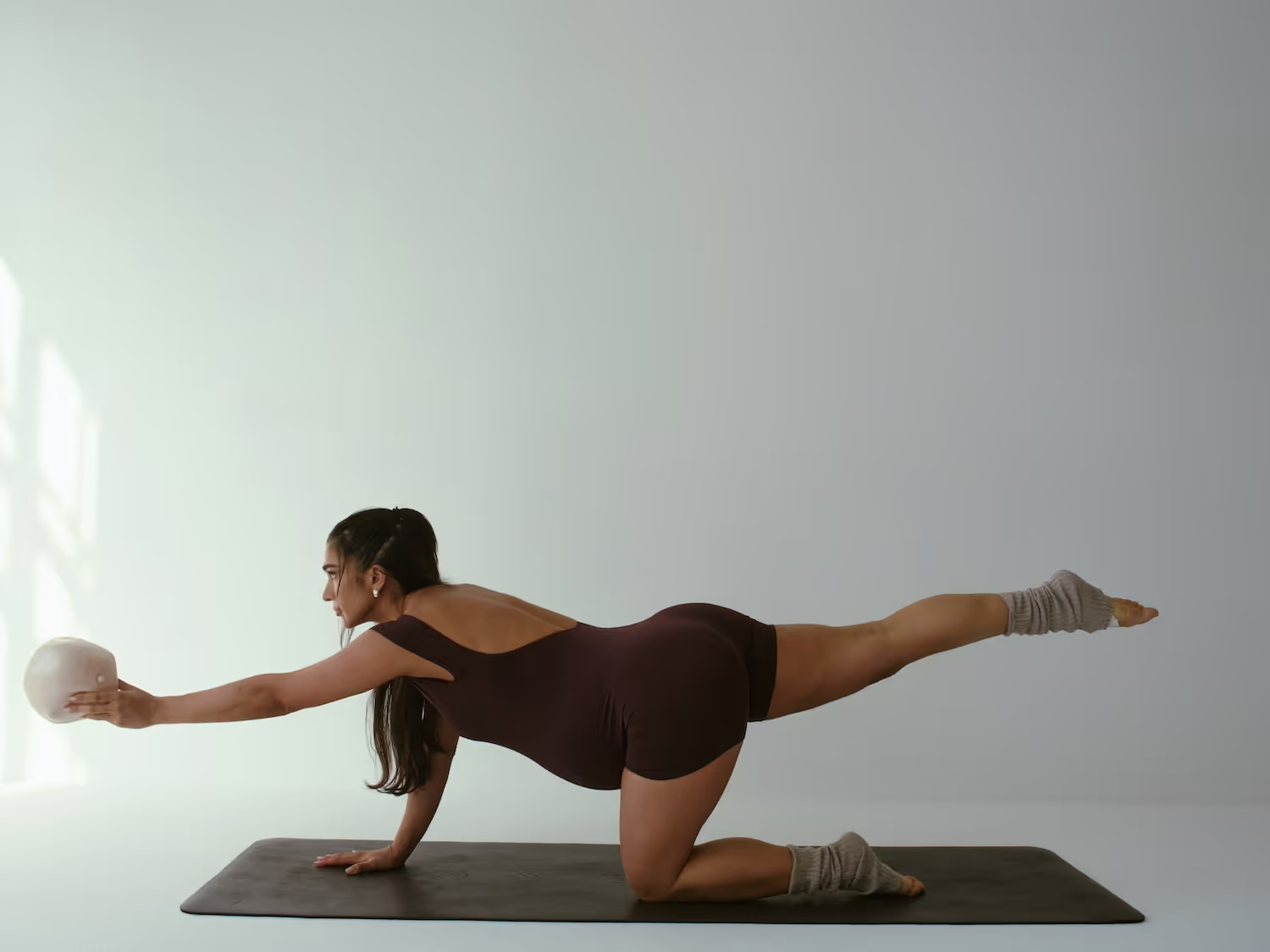
50% discount on annual
Claim 50% off your yearly WeGLOW subscription
Unlock access to WeGLOW for 50% off when you buy an annual plan, very limited offer so hurry
get the dealLimited time offer · Terms apply